
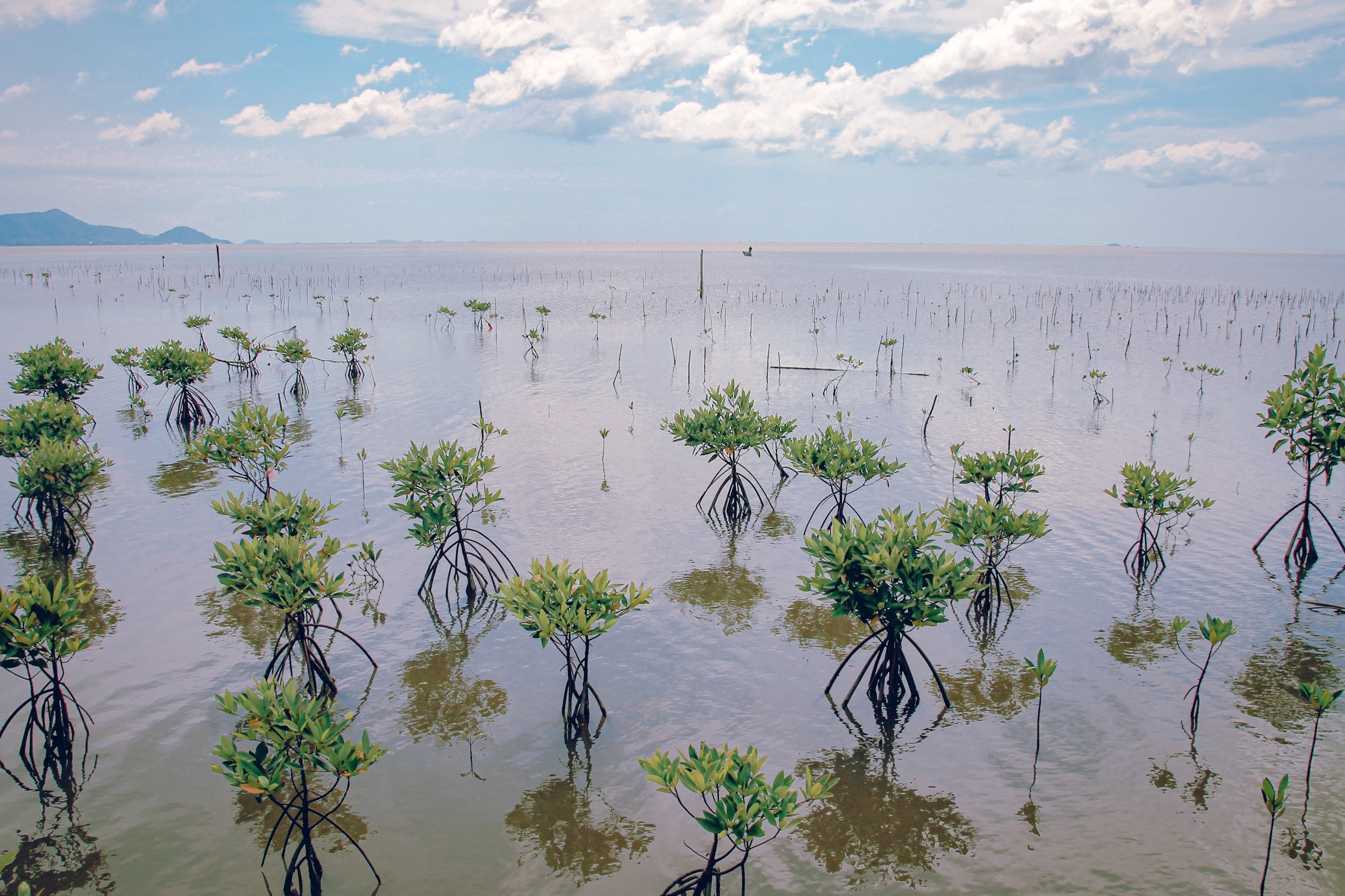

Global climate change has become a serious challenge that requires concrete and sustainable solutions. One approach that has gained increasing global attention is ecosystem-based carbon projects, particularly those utilizing mangrove forests.
As coastal ecosystems, mangroves play a strategic role in climate change mitigation due to their exceptional ability to absorb and store large amounts of carbon. For this reason, mangrove forests are widely recognized as a key pillar of blue carbon projects.
- Blue Carbon and the Concept of Carbon Projects
- Mangrove Forests as Carbon Sinks and Carbon Stores
- The Role of Mangroves in Preventing Carbon Emissions
- Forms of Mangrove Based Carbon Projects
- Economic and Social Value of Mangrove Carbon Projects
- Challenges in Blue Carbon Projects
Blue Carbon and the Concept of Carbon Projects
Blue carbon refers to carbon captured and stored by coastal and marine ecosystems, including mangrove forests, seagrass meadows, and tidal marshes. These ecosystems are unique because they can sequester carbon in their sediments for extremely long periods.
A carbon project, on the other hand, is a planned activity aimed at reducing or removing greenhouse gas emissions through conservation, restoration, or sustainable management of ecosystems. In the context of blue carbon, mangrove forests represent one of the most effective natural systems for long term carbon storage.
Mangrove Forests as Carbon Sinks and Carbon Stores
Mangrove forests have an extraordinary capacity to absorb carbon dioxide from the atmosphere through photosynthesis and store it in both biomass and soil sediments. Compared to terrestrial tropical forests, mangroves can store three to five times more carbon per unit area.
A significant proportion of this carbon is stored belowground in waterlogged, organic rich soils. As long as mangrove ecosystems remain intact, this carbon can be locked away for hundreds to thousands of years, making mangroves highly effective natural carbon sinks.
The Role of Mangroves in Preventing Carbon Emissions
In addition to sequestering carbon, mangrove forests play a crucial role in preventing the release of previously stored carbon. When mangroves are degraded or converted to other land uses, the carbon rich sediments are exposed to oxygen, leading to oxidation and the release of large amounts of carbon dioxide into the atmosphere.
Therefore, protecting mangrove forests through carbon projects not only enhances carbon sequestration but also prevents the release of so called hidden or legacy carbon emissions that can significantly accelerate climate change.
Read more:
How Mangroves Strengthen Climate Resilience Through Nature and Livelihoods
Forms of Mangrove Based Carbon Projects
Mangrove based carbon projects can be implemented through several approaches. Conservation focused projects aim to protect existing, intact mangrove forests from deforestation and degradation, thereby preventing the release of stored carbon.
Restoration and rehabilitation projects focus on replanting mangroves in degraded or abandoned coastal areas, gradually increasing carbon sequestration as vegetation and sediments recover.
In addition, sustainable mangrove management integrates ecosystem protection with local economic activities, ensuring that carbon storage functions are maintained while supporting community livelihoods.
Economic and Social Value of Mangrove Carbon Projects
Mangrove carbon projects provide not only environmental benefits but also significant economic and social value. The carbon sequestered through these projects can be converted into carbon credits that are traded in voluntary or compliance carbon markets.
Revenue generated from carbon credits can be used to finance mangrove conservation and restoration, improve the welfare of coastal communities, and support corporate and governmental commitments to Net Zero Emissions. As such, mangrove based carbon projects contribute directly to sustainable development goals.
Challenges in Blue Carbon Projects
Despite their high potential, mangrove-based blue carbon projects face several challenges. These include the complexity of measuring soil carbon stocks, the need for long term data and monitoring, risks associated with land use change, and compliance with international carbon standards through robust Measurement, Reporting, and Verification (MRV) systems.
However, with sound scientific methodologies, supportive policies, and active involvement of local communities, these challenges can be effectively addressed.
Conclusion
Mangrove forests are a fundamental pillar of blue carbon projects due to their exceptional ability to sequester, store, and prevent the release of carbon at large scales. The development of mangrove based carbon projects represents a strategic solution for climate change mitigation while simultaneously delivering economic and social benefits.
Therefore, the protection and sustainable management of mangrove ecosystems should be an integral part of future carbon service strategies. However, the vast potential of mangrove forests as blue carbon projects cannot be fully realized without structured planning and documentation that meets international standards.
This is where feasibility assessment, baseline studies, carbon stock calculations, and a robust Measurement, Reporting, and Verification system become critical success factors. Without the right approach, methodological gaps and validation risks may hinder the issuance of carbon credits.
If you are a landowner, coastal area manager, company, or local government planning to develop a mangrove-based carbon project, ensure that every stage is prepared credibly and aligned with global standards such as Verra and Gold Standard.
Validerra serves as your documentation and carbon project advisory partner, supporting you in project design documentation, carbon accounting, methodology alignment, and preparation for validation and verification. With a systematic and standards-based approach, Validerra helps transform mangrove potential into a bankable, measurable, and sustainable carbon project.
Consult your blue carbon project plan with Validerra and turn your mangrove initiative into a climate-impact solution that also delivers long-term economic value.
Author: Indah Nurharuni
Editor: Sabilla Reza
References:
Alongi, D. M. (2014). Carbon cycling and storage in mangrove forests. Annual Review of Marine Science, 6, 195–219. https://doi.org/10.1146/annurev-marine-010213-135020
Donato, D. C., Kauffman, J. B., Murdiyarso, D., Kurnianto, S., Stidham, M., & Kanninen, M. (2011). Mangroves among the most carbon-rich forests in the tropics. Nature Geoscience, 4(5), 293–297. https://doi.org/10.1038/ngeo1123
Howard, J., Sutton-Grier, A., Herr, D., Kleypas, J., Landis, E., McLeod, E., Pidgeon, E., & Simpson, S. (2017). Clarifying the role of coastal and marine systems in climate mitigation. Frontiers in Ecology and the Environment, 15(1), 42–50. https://doi.org/10.1002/fee.1451
Kauffman, J. B., & Donato, D. C. (2012). Protocols for the measurement, monitoring and reporting of structure, biomass and carbon stocks in mangrove forests. Center for International Forestry Research (CIFOR).
McLeod, E., Chmura, G. L., Bouillon, S., Salm, R., Björk, M., Duarte, C. M., Lovelock, C. E., Schlesinger, W. H., & Silliman, B. R. (2011). A blueprint for blue carbon: Toward an improved understanding of the role of vegetated coastal habitats in sequestering CO₂. Frontiers in Ecology and the Environment, 9(10), 552–560. https://doi.org/10.1890/110004
Friess, D. A., Rogers, K., Lovelock, C. E., Krauss, K. W., Hamilton, S. E., Lee, S. Y., Lucas, R., Primavera, J., Rajkaran, A., & Shi, S. (2019). The state of the world’s mangrove forests: Past, present, and future. Annual Review of Environment and Resources, 44, 89–115. https://doi.org/10.1146/annurev-environ-101718-033302